
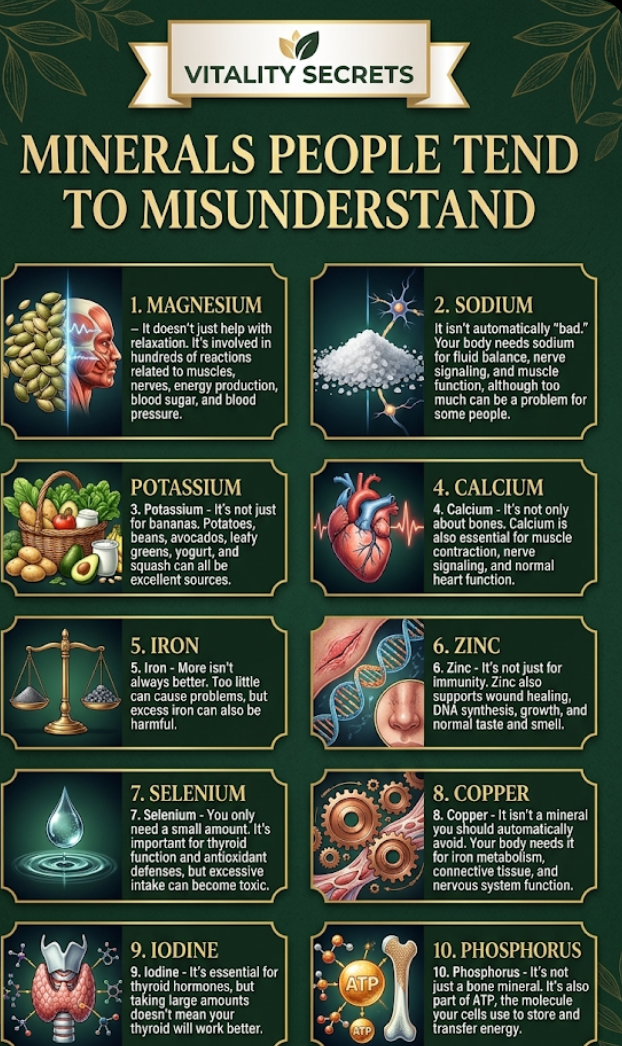
10 Minerals People Tend to Misunderstand
Minerals get reduced to one-line summaries so often that it’s easy to lose sight of everything they actually do. Magnesium becomes “the relaxation mineral,” calcium becomes “the bone mineral,” and iron becomes “more is better,” none of which is quite accurate, or complete. These oversimplifications aren’t harmless either: they can lead people to over-supplement, under-supplement, or avoid minerals unnecessarily based on incomplete information.
Below, we break down 10 commonly misunderstood minerals, correcting the popular misconceptions and explaining what these minerals actually do in the body.
1. Magnesium
The misconception: Magnesium is mainly known as “the relaxation mineral.”
The reality: Magnesium is involved in hundreds of biochemical reactions in the body, related to muscle function, nerve signaling, energy production, blood sugar regulation, and blood pressure. Its association with relaxation and sleep is real, but it’s a small piece of a much bigger functional picture, magnesium is arguably one of the most functionally important minerals in the entire body.
2. Sodium
The misconception: Sodium is automatically “bad” and should be minimized as much as possible.
The reality: Your body genuinely needs sodium for fluid balance, nerve signaling, and muscle function, it’s an essential mineral, not a toxin. The legitimate concern is excessive sodium intake, which can be a problem for blood pressure in sodium-sensitive individuals, but complete avoidance isn’t healthy or necessary for most people. The goal is moderation, not elimination.
3. Potassium
The misconception: Potassium is mainly associated with bananas.
The reality: While bananas do contain potassium, they’re far from the only, or even the best, source. Potatoes, beans, avocados, leafy greens, yogurt, and squash are all excellent sources, and in some cases provide more potassium per serving than a banana does. Potassium plays a critical role in fluid balance, nerve function, muscle contraction, and blood pressure regulation.
4. Calcium
The misconception: Calcium is only about bone health.
The reality: While calcium is indeed essential for bone structure, it’s equally important for muscle contraction, nerve signaling, and normal heart function. In fact, the body prioritizes maintaining stable blood calcium levels for these functions so strongly that it will pull calcium from bones if dietary intake is inadequate, which is part of why chronic low calcium intake affects bone density over time.
5. Iron
The misconception: More iron is always better, especially if you’re feeling tired.
The reality: Iron is essential, but the relationship isn’t simply “more is better.” Too little iron can cause anemia and related symptoms, but excess iron can also be genuinely harmful, contributing to oxidative stress and, in cases of significant overload, damage to organs like the liver. Iron levels should be assessed with bloodwork before supplementing, rather than assumed based on symptoms like fatigue alone, which have many possible causes.
6. Zinc
The misconception: Zinc is mainly known for supporting immune function.
The reality: While zinc genuinely does support immune health, it also plays essential roles in wound healing, DNA synthesis, growth, and normal taste and smell function. Zinc deficiency can actually present with symptoms like poor wound healing or a diminished sense of taste, symptoms that are easy to overlook if you’re only thinking of zinc in the context of colds and immunity.
7. Selenium
The misconception: Since selenium is important, more must be better.
The reality: Selenium is genuinely important for thyroid function and antioxidant defense, but it’s needed only in very small amounts, and this is one mineral where the gap between an adequate intake and an excessive, potentially toxic intake is notably narrow compared to many other minerals. Excessive selenium intake, particularly from concentrated supplements, can lead to selenium toxicity, with symptoms including hair loss, gastrointestinal issues, and nerve damage in severe cases.
8. Copper
The misconception: Copper is something to be wary of or avoid.
The reality: Copper has an undeserved reputation as a mineral to be cautious about, likely due to concerns about excess exposure from certain sources like old plumbing. In appropriate dietary amounts, copper is essential for iron metabolism, connective tissue formation, and nervous system function, and true dietary copper deficiency, while less commonly discussed, can also cause real health problems.
9. Iodine
The misconception: If iodine is essential for thyroid hormones, taking large amounts should improve thyroid function.
The reality: Iodine genuinely is essential, your thyroid gland cannot produce thyroid hormones without it, but taking large amounts doesn’t translate into better thyroid function. In fact, excessive iodine intake can actually disrupt normal thyroid function and, in some cases, trigger or worsen thyroid problems. Adequate intake matters, but more is not simply better when it comes to this particular mineral.
10. Phosphorus
The misconception: Phosphorus is just another bone mineral, similar to calcium.
The reality: While phosphorus does play a role in bone structure alongside calcium, it’s also a core component of ATP, the molecule your cells use to store and transfer energy for virtually every cellular process. Without adequate phosphorus, your body’s fundamental energy production system simply wouldn’t function, making it far more central to overall metabolism than its “bone mineral” reputation suggests.
Why These Misconceptions Persist
Minerals often get reduced to a single, memorable association because it’s easier to communicate and remember, magnesium equals relaxation, calcium equals bones, potassium equals bananas. These associations aren’t wrong exactly, they’re just incomplete, and that incompleteness can lead to real consequences: people avoiding sodium entirely, assuming iron supplementation is always beneficial, or believing that megadosing iodine or selenium is a harmless way to “support” the thyroid.
A Better Way to Think About Minerals
Rather than reducing each mineral to a single function, it’s more accurate, and more useful, to think of minerals as interconnected players in a complex system. Many minerals depend on each other for proper absorption and function, and imbalances, whether too much or too little, can have cascading effects. This is part of why a varied, whole-foods-based diet tends to serve overall mineral status far better than focusing intensely on any single “hero” mineral in isolation.
Frequently Asked Questions
Is it possible to get too much of a mineral from food alone?
For most minerals, it’s genuinely difficult to reach harmful levels through food alone, since whole foods contain minerals in balanced, moderate amounts. Mineral toxicity is far more commonly associated with concentrated supplements, particularly when taken in high doses without medical guidance.
Should I take a multivitamin with minerals just to be safe?
For most healthy adults eating a varied diet, a standard multivitamin is a reasonable, low-risk choice, but it’s not automatically necessary, and it’s not a substitute for addressing a specific, diagnosed deficiency, which often requires more targeted, higher-dose supplementation guided by a healthcare provider.
How do I know if I actually have a mineral deficiency or excess?
The only reliable way to know is through blood testing ordered by a doctor. Symptoms of deficiency and excess can sometimes overlap or be vague, like fatigue or digestive changes, making self-diagnosis unreliable.
Which mineral is most commonly both under- and over-consumed?
Sodium is a notable example, since some people consume far more than recommended through processed foods, while others, particularly those following very restrictive low-sodium diets without medical guidance, can end up with inadequate intake, both of which can cause problems in their own way.
This article is intended for general informational purposes and is not a substitute for professional medical or nutritional advice. If you suspect a mineral deficiency or excess, or are considering supplementation, consult your healthcare provider or a registered dietitian.