
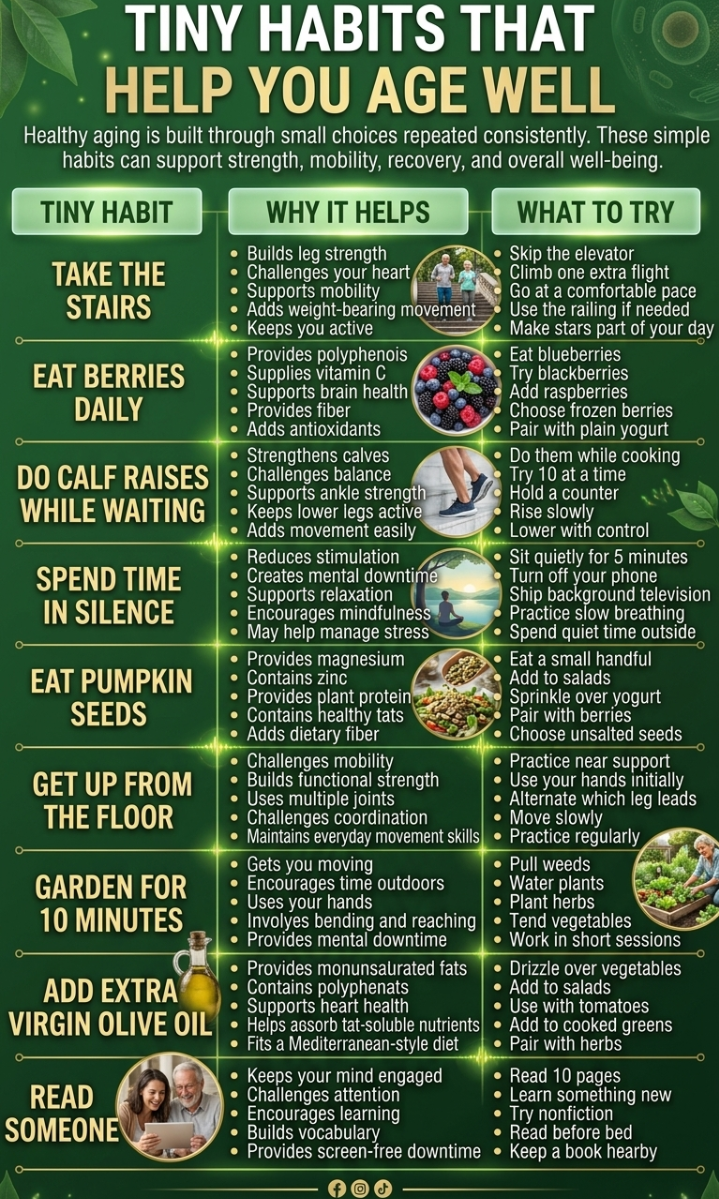
10 Tiny Habits That Help You Age Well
Healthy aging isn’t the result of one big lifestyle overhaul. It’s built through small choices, repeated consistently, day after day. The way you move through your kitchen, the snacks within reach, whether you take the stairs or the elevator — these tiny decisions add up over months and years in ways that matter far more than most people realize.
The good news is that none of these habits require a gym membership, a strict diet, or hours of free time. Below are 10 simple, low-effort habits that support strength, mobility, recovery, and overall well-being as you age, along with the reasoning behind each one and practical ways to start.
Why Small Habits Matter More Than Big Changes
Most people overestimate what they can do in a single dramatic effort and underestimate what small, consistent habits can do over time. A single trip up the stairs won’t change your fitness. Ten years of consistently choosing the stairs will. This is the core idea behind healthy aging: it’s less about intensity and more about frequency and consistency.
These 10 habits are designed to be realistic enough to actually stick with, which is what makes them effective in the long run.
1. Take the Stairs
Why it helps: Climbing stairs builds leg strength, challenges your heart, supports mobility, and adds weight-bearing movement into your day, all of which help protect bone density and cardiovascular health as you age.
What to try:
Skip the elevator when you reasonably can
Climb one extra flight before stopping
Go at a comfortable pace rather than rushing
Use the railing if needed, there’s no shame in it
Make stairs a natural part of your daily routine rather than something to avoid
2. Eat Berries Daily
Why it helps: Berries provide polyphenols and vitamin C, support brain health, and are rich in fiber and antioxidants, a combination that has been studied for its potential role in supporting cognitive function and reducing oxidative stress over time.
What to try:
Eat blueberries as a simple daily snack
Try blackberries or raspberries for variety
Add frozen berries when fresh isn’t available or affordable
Pair berries with plain yogurt for a fiber-and-protein combination
3. Do Calf Raises While Waiting
Why it helps: Calf raises strengthen the calves, challenge your balance, support ankle strength, and keep the lower legs active, which becomes increasingly important for fall prevention and mobility as we age.
What to try:
Do them while cooking, brushing your teeth, or waiting for coffee
Try sets of 10 at a time throughout the day
Hold onto a counter for balance if needed
Rise slowly and lower with control rather than bouncing
4. Spend Time in Silence
Why it helps: Quiet time reduces overstimulation, creates genuine mental downtime, supports relaxation, encourages mindfulness, and may help manage stress, which is closely tied to long-term health outcomes including inflammation and sleep quality.
What to try:
Sit quietly for just 5 minutes to start
Turn off your phone during that time
Skip background television, even if it’s just for a few minutes
Practice slow, intentional breathing
Spend quiet time outside when possible for added benefit
5. Eat Pumpkin Seeds
Why it helps: Pumpkin seeds provide magnesium and zinc, contain plant-based protein, offer healthy fats, and add dietary fiber, all in a small, portable package that’s easy to work into daily eating habits.
What to try:
Eat a small handful as a snack
Add them to salads for crunch
Sprinkle them over yogurt or oatmeal
Pair them with berries for a simple, balanced snack
Choose unsalted varieties to keep sodium in check
6. Get Up From the Floor
Why it helps: The ability to get up and down from the floor without assistance challenges mobility, builds functional strength, uses multiple joints together, challenges coordination, and helps maintain the everyday movement skills that tend to fade if they’re not practiced.
What to try:
Practice near a sturdy piece of furniture for support at first
Use your hands initially if needed, that’s completely fine
Alternate which leg leads as you stand
Move slowly and with control rather than rushing
Practice this regularly, not just once
7. Garden for 10 Minutes
Why it helps: Gardening gets you moving, encourages time outdoors, engages your hands, involves functional bending and reaching, and provides valuable mental downtime, making it one of the more enjoyable ways to sneak movement into your day.
What to try:
Pull weeds for a few minutes
Water your plants by hand rather than with an automated system
Plant herbs you’ll actually use in cooking
Tend to vegetables if you have the space
Work in short sessions rather than long, exhausting ones
8. Add Extra Virgin Olive Oil
Why it helps: Extra virgin olive oil provides monounsaturated fats and polyphenols, supports heart health, helps the body absorb fat-soluble vitamins from vegetables, and fits naturally into a Mediterranean-style eating pattern that has been widely studied for its association with healthy aging.
What to try:
Drizzle it over vegetables before serving
Add it to salads in place of heavier dressings
Use it with tomatoes and fresh herbs
Cook vegetables in it instead of more processed oils
Pair it with fresh herbs for extra flavor and polyphenols
9. Read Something Every Day
Why it helps: Reading keeps your mind engaged, challenges attention, encourages ongoing learning, builds vocabulary, and provides valuable screen-free downtime, all of which support cognitive engagement as you age.
What to try:
Read just 10 pages a day, no more required
Learn something new through nonfiction
Try a nonfiction book on a topic you’re curious about
Read before bed instead of scrolling your phone
Keep a book nearby so it’s an easy, low-friction habit
10. Call Someone You Love
Why it helps: Social connection supports emotional well-being, reduces isolation, provides emotional support, keeps relationships strong, and is one of the most consistently studied factors associated with healthy, long-term aging.
What to try:
Call a friend just to check in, no agenda needed
Visit family when you can
Eat together instead of separately when possible
Schedule regular meetups rather than leaving them to chance
Make connection a habit, not an afterthought
How to Actually Stick With These Habits
Trying to adopt all 10 habits at once is a common way to abandon all of them within a week. Instead:
Pick one or two to start. Master those before adding more.
Attach new habits to existing routines. Calf raises while the coffee brews, berries with breakfast, a call to a loved one during your evening walk.
Track it simply. A basic checklist or calendar mark is often more effective than a complicated app.
Expect imperfection. Missing a day doesn’t erase progress. What matters is returning to the habit, not achieving a perfect streak.
Reassess after a month. Notice what’s sticking naturally and what still feels like a chore, and adjust accordingly.
Frequently Asked Questions
Do I need to do all 10 habits every single day to see benefits?
No. These habits are meant to layer gradually over time. Even consistently practicing three or four of them can make a meaningful difference compared to practicing none at all.
At what age should I start building these habits?
There’s no specific starting age. These habits support strength, mobility, and well-being at virtually any stage of adulthood, and starting earlier simply means more years of cumulative benefit.
Can these habits replace exercise or medical care?
No. These are supportive daily habits, not a substitute for regular exercise, medical checkups, or professional guidance, especially for anyone managing an existing health condition. Always consult your doctor about your individual needs.
Which habit has the biggest impact on healthy aging?
There isn’t a single “most important” habit, since strength, nutrition, mobility, mental health, and social connection all interact with one another. A well-rounded combination tends to matter more than optimizing any single habit in isolation.
This article is intended for general informational purposes and is not a substitute for professional medical advice. If you have specific health concerns, consult your healthcare provider before making significant lifestyle changes.